
Saturday, 13 May 2021

- IaaS (Infrastructure as a Service) hardware is virtualized in the cloud: it allows the consumer to rent the IT resources on which to install and run their software. The consumer does not manage or control the cloud infrastructure but has control over the OS, storage, application deployment and network selection.
- PaaS: allows the consumer to use the cloud infrastructure to develop and deploy applications using languages and tools supported by the provider (eg. Java, python, .Net). This model proposes a software environment in which a developer can create and customize solutions within a context of development tools that the platform provides.
- SaaS: The provider’s web applications are accessible as services. The consumer does not manage or control the infrastructure or capabilities of the applications. The most complete service model is one that offers software and hardware as a joint service, i.e. SaaS provides the infrastructure, software, solution and entire provisioning stack as a global service. Software as a Service (SaaS) can be described as software that is deployed in a hosting service and can be accessed globally over the internet via browser, mobile, tablet, etc. And where all aspects other than the interaction with the application itself are transparent to the user,
In the SaaS model, users pay for the use of the service through subscription fees, valid for a certain period of time, as in the case of a rental, the fundamental characteristics of this model can be summarized as:
• The software is available globally via the internet and on demand.• The subscription model is usually licensed or usage-based and is billed monthly on a recurring basis.• Everything related to operations is the responsibility of the provider• Updates, improvements, evolutions or patches in the application, must always be transparent to the user and of course should not make any configuration.
- BPaaS: includes any business process (horizontal or vertical) offered through the Cloud model through the web. BPaaS is a service model where the applications offered in the cloud are of the business process or workflow type. In this sense, BPaaS could be considered as the upper level of the different layers that are distinguished in the cloud, or, as the following figure represents, a subset or particularization of the SaaS layer.
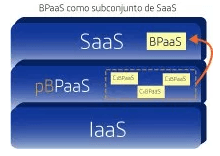
These business processes can combine, explicitly or implicitly, legacy applications of the client (in its own CPD), with applications offered by the service provider in SaaS mode (in provider CPD) and with third-party applications (in provider CPD or directly from third-party infrastructure).
The BPaaS service model therefore requires platform-specific components for the development and execution of its typology of applications.
Among these platform-specific components we can find:
- BPM (Business Process Management) / BAM (Business Activity Monitoring), with flow modeling and development tools, workflow execution engines and real-time business monitoring.
- Application and service integration components: EAI (Enterprise Application Integration), ESB (Enterprise Service Bus), adapters, etc.
- Data integration components: ETL (Extracting, Transformation and Loading), EII (Enterprise Information Integration), etc.
- Components for integrating presentation elements (portlets, contents).
- Reporting components
