
Thursday, 11 June 2015
autanabp
A CRM is much more than a technical solution, and before implementing any type of application to automate and improve customer relationship management, an organization must understand its customer market and define a strategy to change the way it does business to be customer-centric. You must also prepare your staff for the cultural change that comes with the new approach to handling customer-related issues (e.g., call centers and sales reps must learn new ways to interact with customers)
In other words, it is important that a good CRM strategy and preparation is carried out first, so that in this way the application of this technical solution can be successful.
We want to present a process (which presents the approach recommended by James Martin Co) for the implementation of Siebel in an organization and that serves as a guide in this type of projects, which allows us to address the requirements of the organization effectively.
The scope of this process does not include assessing an organization’s readiness (or not) for a CRM. This assessment should be conducted before to determine the organization’s reasons in implementing the new application and what kind of functionality would best serve the organization in achieving its goals of improving customer relations. The strategic decision to implement a CRM using Siebel as a technical solution should be made before launching a project based on this process.
In order to understand and take advantage of Siebel’s many features and master the complexities of implementing it, all project team members (including project team members from the customer’s organization) must undergo Siebel Enterprise Applications training, if they do not already have this extensive knowledge.
Los temas relevantes del entrenamiento podrían incluir Using Siebel Enterprise Applications, Application Administration, Marketing Administration, Service Administration, Synchronization Administration y Configuration and Customization.
This process also assumes that all members of the project team have an understanding of Siebel’s look and feel and functionalities and are familiar with its terminology.
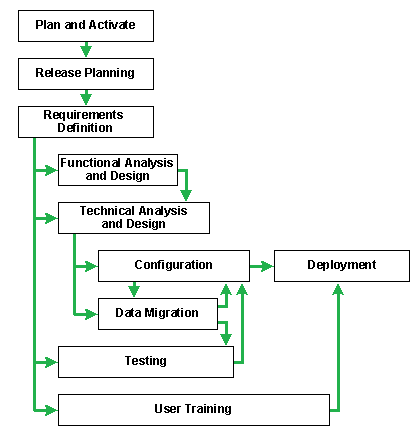
The following stages of development comprise this process:
- Release Planning: At this stage, project managers consult with the management of the organization the high-level functionalities that should be implemented in the application to meet the predefined requirements by business.
- Requirements Definition: During the Release Planning stage, a high level of detail will allow us to specify which Siebel components to implement to meet the company’s objectives. The purpose of the Requirements Definition stage is to determine from end users what functionalities they expect and what they would like, in order to use the application to do their respective jobs and achieve those business goals. If the requirements are poorly defined, the failure of the project is assured.
- Functional Analysis and Design: This stage focuses on analyzing the data and functional requirements and breaking them down into components to create a stable functional specification, and from which to carry out the configuration work.
- Technical Analysis and Design: The purpose of this stage is to identify the components and configuration requirements of the hardware/software technical architecture to support the users of the application; planning the increase of users and transaction volumes are some of the tasks that compose it.
- Configuration: During the configuration phase, the application is configured based on the functional specification.
It is important to involve users in configuration activities, to ensure their satisfaction with the appearance of the application, as it transforms from a design specification to a tangible and functional system.
- Data Migration: Data migration is the set of procedures for moving data from source systems to Siebel. It is done both for the systems that Siebel is replacing and for the systems with which Siebel will connect permanently. It can occur simultaneously with configuration.
- Testing: The purpose of this stage is to conduct user acceptance testing (UAT) and performance testing of the configured system.
- Deployment: It is the roll out or deployment of the application. It must cover one group of users at a time, according to the release strategy defined in the Release Strategy.
- User Training: It is of vital importance for the success of the new system, to train business users in their operations and to train the support staff of the system (help desk), both in the operation of the system and the activities related to the administration and interaction with other systems (among other things) In addition, the development of new procedures may be necessary, policies, etc., to facilitate the cultural change needed to use the app.
The main activities at this stage include: Preparing for cultural changes; Develop training materials; Manage user training; Assess learning.
There are also two stages that can be added to this process and that can be used as a guide to establish, monitor and conclude the project:
- Plan and Activate: The objective of this stage is basically to explicitly define the objectives, limitations and scope of the project.
- Control and End: Controlling the management of the project continuously from beginning to end, is in summary the purpose of this stage.
The following diagram shows the dependency relationships between the stages of this process.
The development of all the stages can be consulted on this Project Management website, which we have used as the main source.
https://www.projectmanagement.com/process/processMain.cfm?ID#redirect
